




Exosomes and Melasma: A Smarter Way to Treat Stubborn Pigmentation
Recurring, emotionally exhausting, and notoriously difficult to treat—can exosome technology change the way we think about melasma?
By Exopurebeauty Some skin concerns are frustrating.
Melasma is different.
Melasma can feel relentless. It fades, then returns. It improves, then darkens again. You invest in brightening products, laser sessions, peels, strict routines—and still find yourself facing the same patches months later, sometimes worse than before.
That is why melasma is often described as one of the most difficult pigmentation conditions to manage well.
Not because nothing works.
But because too many approaches only treat what is visible on the surface, without changing the deeper environment that keeps melasma coming back.
And that is exactly why exosomes are becoming so interesting in this conversation.
Because for melasma, the future may not lie in trying to erase pigment more aggressively.
It may lie in helping skin become less likely to keep creating the same problem in the first place.
1. Why Melasma Is So Difficult to Treat
Among all pigmentation concerns, melasma has earned a reputation as one of the most stubborn for a reason.
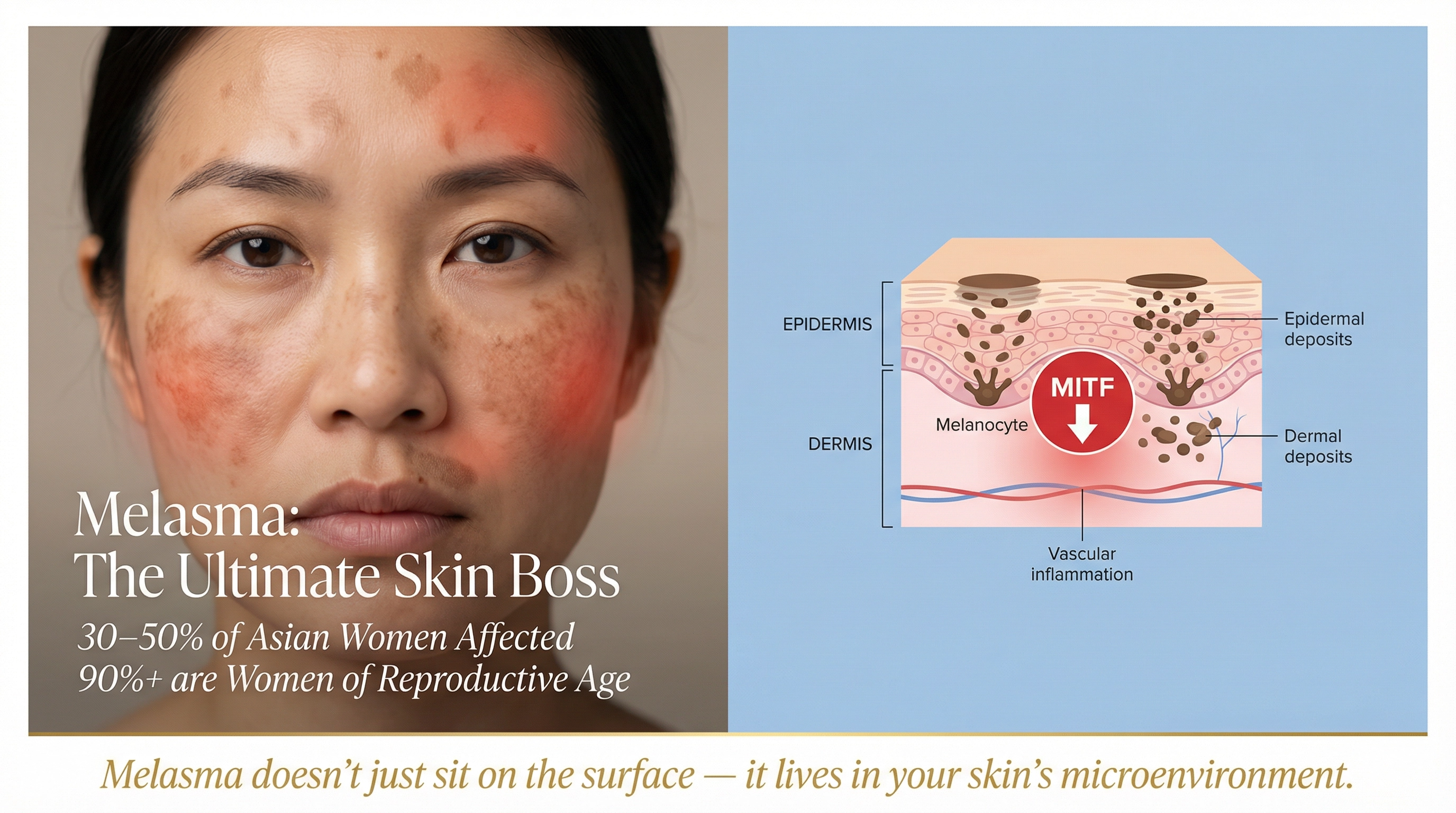
Unlike freckles, which tend to be smaller and more evenly distributed, or sun spots, which are often more localized, melasma usually appears as larger, diffuse, irregular patches. It often shows up symmetrically across the cheeks, forehead, upper lip, or jawline. The borders can be blurred. The tone can vary. And the emotional impact is often far greater than people expect.
What makes melasma especially difficult is not just its appearance.
It is its tendency to return.
A bit of sun.
A hormonal shift.
Stress.
Heat.
Inflammation.
A poorly timed treatment.
And suddenly, the skin seems to remember everything.
That is why melasma often feels less like a spot problem and more like an unstable skin state.
For many women—especially during reproductive years, postpartum transitions, or times of hormonal fluctuation—melasma becomes one of the most persistent complexion challenges they face.
2. Why Traditional Melasma Treatments So Often Fall Short
Most conventional melasma treatments focus on one goal:
remove the pigment.
And while that makes sense on paper, it often proves incomplete in practice.
Hydroquinone
Hydroquinone has long been one of the best-known ingredients for reducing visible pigmentation. But long-term use raises concerns around irritation, rebound pigmentation, uneven lightening, and in some cases a compromised skin appearance over time.
Acids and Retinoids
Acids and retinoids can help accelerate surface turnover and encourage the shedding of pigmented cells. But melasma is rarely only a surface issue. For deeper or mixed-type melasma, this approach may not be enough on its own—and for sensitive skin, it may even increase irritation.
Lasers and Light-Based Treatments
These can be effective in selected cases, but melasma is notoriously reactive. If energy settings are too aggressive, especially in pigmentation-prone skin, treatment itself can trigger inflammation and rebound darkening.
That is one of the greatest fears in melasma care:
not just no improvement, but worse pigmentation after intervention.
Oral Support Strategies
Certain internal approaches may help some users, but they often require long-term commitment and may come with limitations, contraindications, or relapse once stopped.
And this is the common weakness behind so many melasma strategies:
they try to move the pigment, but they do not fully stabilize the environment that keeps producing it.
Melasma is not just a melanin problem.
It is also a problem of inflammation, vascular instability, barrier weakness, and skin-environment imbalance.
That changes everything.
3. How Exosomes May Help Address Melasma More Intelligently
What makes exosomes so compelling in melasma care is that they may help support multiple layers of the problem at once.
Instead of focusing only on visible pigment, exosome technology is exciting because it is associated with a broader skin-regulating role—one that speaks to signaling, inflammation, recovery, and skin resilience.
1. Supporting a More Balanced Melanin Pathway
Melasma is deeply tied to dysregulated pigment signaling.
Exosomes are being studied and discussed because they are associated with signaling molecules that may help support a healthier melanocyte environment and reduce overactive pigment behavior at the source.
That matters, because the real goal in melasma is not only to lighten what is already there.
It is to make the skin less likely to keep overproducing visible discoloration.
2. Helping Calm the Inflammatory and Vascular Component
One of the biggest shifts in modern melasma research is the recognition that melasma is not purely pigmentary. It also involves chronic low-grade inflammation and vascular involvement.
This is one of the reasons melasma can be so reactive and recurrent.
Exosomes are particularly interesting here because they are associated with anti-inflammatory and regenerative signaling. That may help support a calmer, more stable environment—one that is less likely to keep fueling visible pigment rebound.
3. Supporting Safer Recovery Around Energy-Based Treatments
For users combining melasma care with lasers or light-based therapies, post-treatment inflammation is a major concern.
Exosome technology has become increasingly relevant in this setting because it may help support recovery, reduce visible irritation, and make the treatment window feel more controlled—especially in skin that is already prone to pigmentation after inflammation.
4. Helping Rebuild the Barrier and Restore Skin Stability
Melasma-prone skin is often more sensitive than it first appears.
In many cases, the barrier is already compromised, and transepidermal water loss is elevated. That makes the skin more vulnerable to environmental triggers, irritation, and persistent unevenness.
Because exosomes are associated with repair-focused pathways, they are increasingly discussed not just for brightening, but for helping restore barrier function and overall skin stability.
And for melasma, stability is everything.
4. What the Improvement Pattern Often Looks Like
Melasma is not a condition that rewards impatience.
The users who do best are usually the ones who stop chasing overnight lightening and start focusing on steady, layered improvement.
A realistic progression often looks like this:
Weeks 1–2
The skin may begin to look brighter overall.
The complexion feels more even.
The edges of visible patches may start to soften slightly.
Around Week 4
Pigmented areas often begin to look lighter in tone.
Many users find they need less concealer and less corrective makeup.
Around Week 8
When combined with professional treatment, pigment reduction may become more noticeable, while post-treatment darkening may feel less intense than expected.
Around Week 12
The complexion often looks more unified overall.
The skin may feel less reactive.
And perhaps most importantly, the relapse cycle can begin to slow.
That last part matters more than people realize.
With melasma, success is not just how quickly a patch fades.
It is how long the skin can hold onto that improvement without falling back into the same cycle.
5. Different Types of Melasma, Different Expectations
Not all melasma behaves the same way, which is why expectations need to be individualized.
Epidermal Melasma
This more superficial type tends to respond best to topical and light-based approaches when the skin is also well-supported. Exosomes may work especially well here as part of a brightening-plus-repair strategy.
Dermal Melasma
Because pigment sits deeper, improvement tends to be slower and more partial. In these cases, exosome support may be most valuable as part of a broader plan involving delivery enhancement and long-term control.
Vascular Melasma
When redness and vascular reactivity are more obvious, inflammatory control becomes especially important. This is where the calming and skin-balancing relevance of exosomes becomes particularly compelling.
Mixed Melasma
This is often the most realistic category in practice. It usually requires staged treatment, consistent maintenance, and patience. Exosomes may help by improving the skin’s recovery behavior and reducing the volatility of the overall condition.
The key is not to treat melasma like a simple spot.
It is better understood as a chronic, multi-factor skin pattern—one that responds best when the treatment strategy is just as multi-dimensional.
6. What People With Melasma Need to Hear Most
If you live with melasma, there are a few truths worth holding onto.
Sun Protection Is Non-Negotiable
This is not seasonal.
This is not optional.
This is not something sunscreen alone can fully solve.
Daily SPF 50+ matters, but physical protection matters too: hats, shade, umbrellas, and avoiding unnecessary heat exposure whenever possible.
Stress and Sleep Matter More Than Most People Think
Melasma is one of the clearest examples of how internal state shows up on the skin. Stress, poor sleep, emotional strain, and hormonal disruption all have the power to make the condition more unstable.
Fast Brightening Is Usually the Wrong Goal
The more aggressively people chase quick fading, the more likely they are to trigger irritation and rebound.
Melasma rewards discipline, not force.
Treatment Quality Matters
Not all exosome products, professional protocols, or brightening systems are equal. Traceability, formulation stability, and product integrity matter far more than trend language.
Lifestyle Support Still Plays a Role
Adequate sleep, a lower-inflammatory lifestyle, and consistent skin-barrier support do not sound glamorous—but they often make the difference between temporary improvement and meaningful long-term control.
7. Where Exopurebeauty Fits Into the Melasma Conversation
At Exopurebeauty, exosome technology is not positioned as a shortcut.
It is positioned as a smarter support system.
That means supporting the skin not only in how it looks, but in how it behaves:
how it recovers, how it responds to inflammation, how stable the barrier remains, and how likely the complexion is to stay even over time.
For melasma-prone skin, that approach matters.
Because the goal is not just temporary fading.
It is a healthier, calmer, more resilient-looking complexion that is less vulnerable to the same repetitive pattern.
That is the promise of intelligent skin support.
Not perfection.
Not fantasy.
But a better trajectory.
Final Thoughts
Melasma has earned its reputation as one of the hardest pigmentation conditions to manage.
It is recurrent.
It is layered.
And it rarely responds well to simplistic solutions.
That is exactly why exosomes are such an important development.
They offer a way to think beyond “remove the pigment” and toward a more complete goal:
restore the skin environment that makes recurrent pigmentation less likely to thrive.
And for melasma, that may be the most meaningful shift of all.
Exopurebeauty believes the future of pigment care is not harsher correction—it is smarter recovery, calmer skin, and a complexion that can finally begin returning to itself.
Read more
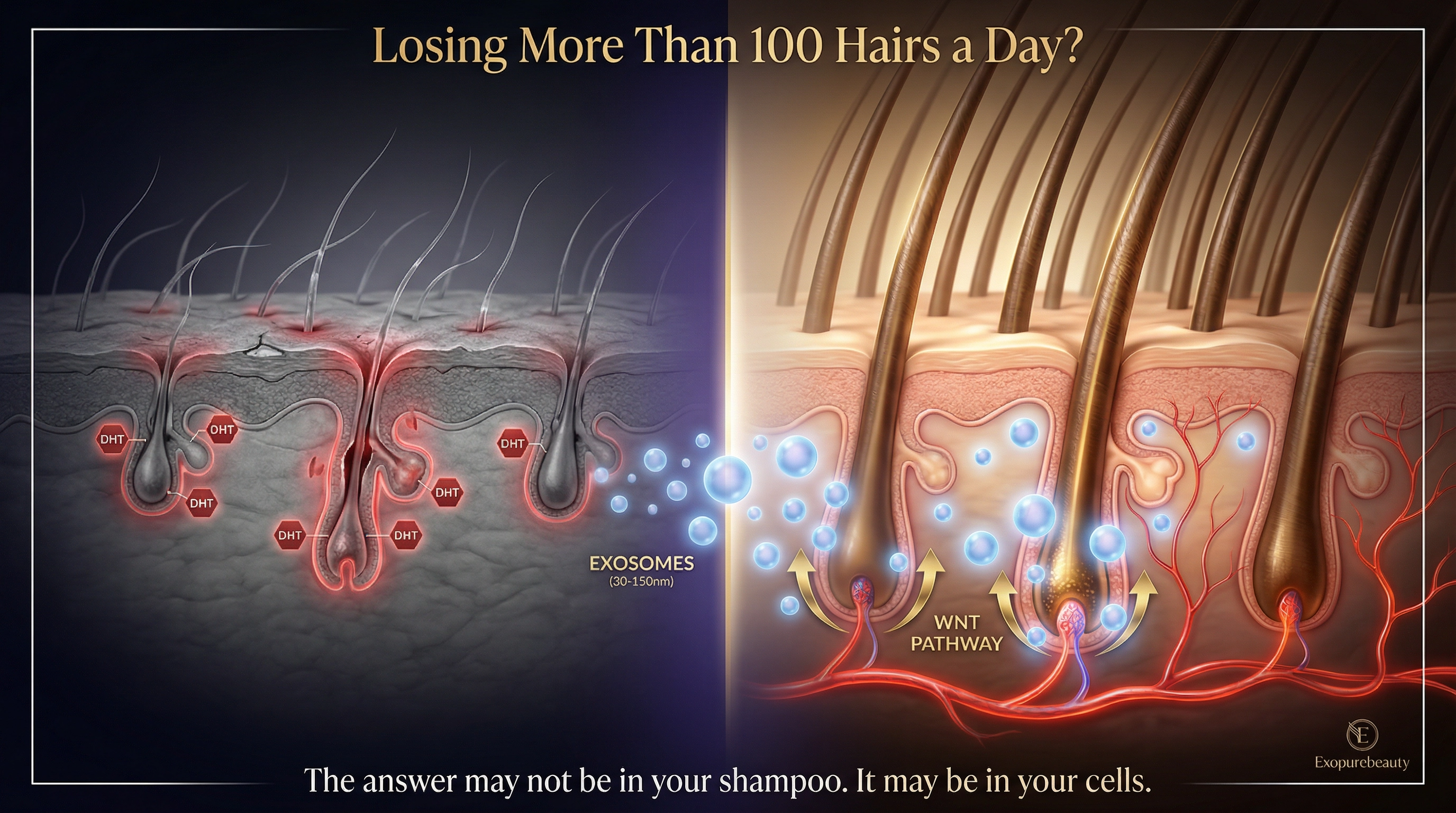
Discover how exosome technology may help support hair follicle renewal, reduce shedding, improve scalp health, and promote fuller-looking hair through a more advanced regenerative approach.

Stop fighting your skin with harsh acids. Discover how exosome therapy targets the root cause of adult acne by restoring immune balance and repairing the skin barrier.